
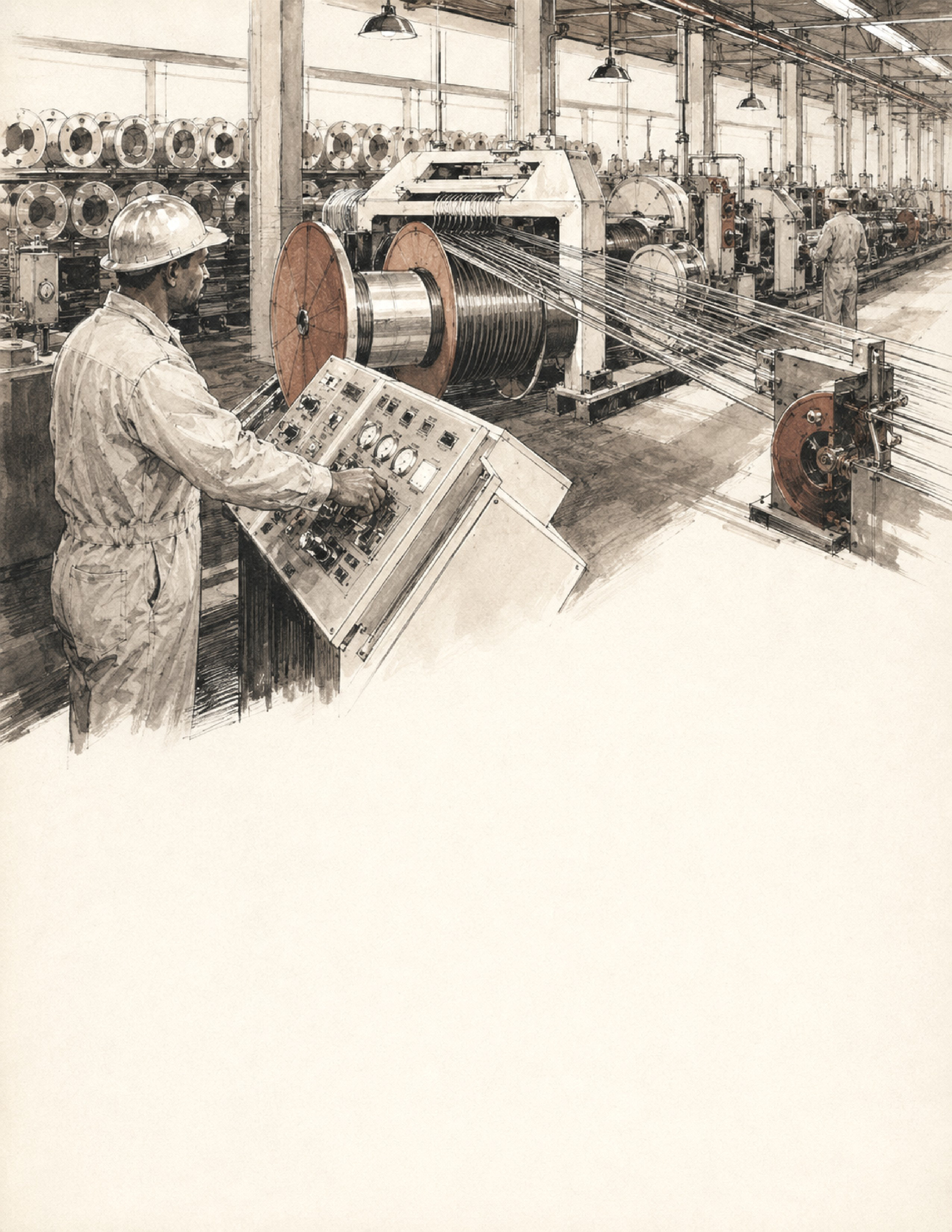
In 1976, the Okonite Company was 98 years old and in the throes of a succession crisis. Founded in Passaic, New Jersey, in 1878, it was the oldest cable manufacturer in the country and made the insulated wire and cable that carried electricity through American cities, the Statue of Liberty, and Thomas Edison’s Pearl Street Generating Station. The company had changed hands three times in a decade before landing in the portfolio of the notorious conglomerator James “Jimmy” Ling’s Omega-Alpha, Inc., a Dallas conglomerate that entered into federal receivership in December 1974.2
Okonite was a profitable, wellmanaged, and strategically useful company, but due to its parent company, it was about to be liquidated or sold off by a bankruptcy court a thousand miles from its plants. This was the last thing that Passaic County needed, with unemployment having run between 23 and 25 percent for most of the prior year.3
Okonite’s president, Victor Viggiano, had read a newspaper account of a $5 million federal award by the U.S. Economic Development Administration (EDA) that helped the employees of a South Bend, Indiana, machine toolmaker buy their company the year before. He called his congressman, Robert Roe, who happened to chair the House subcommittee overseeing EDA to explore how the federal government could similarly finance a sale of Okonite to its employees.4
The structure that Congressman Roe, EDA, and Okonite assembled was, by the standards of any era, a sophisticated innovation of development finance. The EDA awarded a $13 million grant to New Jersey’s Department of Labor and Industry; the state channeled those funds through the New Jersey Economic Development Authority (NJEDA), which re-lent them to Okonite’s newly formed employee stock ownership trust at 3 percent interest over 25 years, with a 2-year moratorium on principal. Above that sat a $27 million, 5-year bank facility at 11 percent from a syndicate of seven banks led by Bank of America, of which roughly $25 million was initially available for the purchase and the balance reserved for working capital.5
The price itself was set by open auction in the Omega-Alpha bankruptcy. The trustees accepted the ESOP’s $38 million all-cash bid in February 1976, but the auction reopened in June, when Italian cable manufacturer Pirelli returned with a $41 million all-cash offer. The EDA grant could not be increased further and the syndicate would go no higher than $27 million; Viggiano instead committed to managing the business so that the entire facility could fund the purchase, bringing available funds to $40 million, still $1 million short of Pirelli. The final layer was a $4 million first mortgage on Okonite’s North Brunswick plant, placed in equal shares with Franklin State Bank and Fidelity Union Trust Company. The plant was an aging, single-purpose facility that no institution would lend against on its own; the loan closed only because NJEDA guaranteed 50 percent of it, with Okonite pledging a $250,000 certificate of deposit to each lender to secure the guarantee. On June 29, 1976, the ESOP submitted its fifth and final bid of $44 million in cash plus a waiver of its claims against Omega-Alpha, topping Pirelli, and the sale closed the following day. The three layers together financed a $44 million purchase, won at open auction against strategic buyers, that turned roughly 1,900 workers into employee owners.6
Three design details warrant more attention than they received at the time. First, the federal money was structured to revolve: once Okonite repaid its loan, NJEDA would lend the funds out again “to aid other ailing industries,” with half reserved for distressed counties and half available statewide.7
Second, the deal capitalized NJEDA as a modern development finance institution. Until 1976, NJEDA had arranged some $250 million in financing for New Jersey companies entirely as a conduit for private lenders. The Okonite award gave the Authority lendable capital of its own for the first time in its existence.8 This is not just a matter of historical reconstruction. Today, the loan sits on NJEDA’s own records as EDA Award No.
01-19-01468 – the “OKONITE RLP,” dated May 26, 1976, made under Title IX of the Public Works and Economic Development Act. It was the first of 5 revolving loan funds awards that NJEDA reports were initially capitalized at $21.4 million and went on to support nearly 850 loans exceeding $200 million: a 9:1 ratio of lending to capitalization.9 Third, NJEDA’s role was not confined to lending, but also consisted of strategic credit enhancements. In guaranteeing half of the North Brunswick mortgage, NJEDA stood behind private lenders on a contingent basis and secured its own exposure with cash collateral posted by the borrower. In a single transaction, the state through NJEDA deployed both funded capital (the re-lent federal grant) and a credit enhancement (a partial guarantee backed by pledged deposits), the same complementary pairing this playbook’s toolkit contemplates five decades later. The guarantee is also why the deal closed at all: it converted an unmortgageable plant into $4 million of senior private credit at the precise moment the auction demanded it.10 New Jersey’s Commissioner of Labor and Industry, Joseph Hoffman, described the transaction at the time as “a classic exercise in true capitalism. It makes capitalists out of workers.”11 He was a Democratic appointee describing a Republican-era federal agency’s largest-ever employee ownership investment, made under a tax innovation championed by Democratic Senator Russell Long of Louisiana that was then barely 2 years old. Employee ownership arrived in American development finance as bipartisan infrastructure, and it has remained so ever since.
The purchase of Okonite by its employees closed in June 1976. The company’s own history states it plainly: “In June 1976, Okonite became the largest company in the United States to be owned by its employees through an [Employee Stock Ownership Plan].”12 Fifty years later, the company is still there and 100 percent employee-owned. From its Ramsey headquarters and six plants across the country (including in Paterson, New Jersey, where it was operating at the time of the ESOP buyout), Okonite today supplies cable to electric utilities across distribution, transmission, and generation, and to wind farms, solar farms, and data centers.13 The workers who bought their company to escape a conglomerate’s bankruptcy built one of the most durable and essential manufacturers in the United States, and the institution that financed them, NJEDA, is today one of the most capable state development finance agencies in the country.
Okonite was not a one-off transaction for a state or municipal government, and certainly not for the federal government. It was the second execution of an emerging federal template (the Wall Street Journal at the time called Okonite “the first concern to set out on the specific trail blazed by South Bend Lathe,” the 1975 Indiana transaction in which a $5 million grant to the City of South Bend was re-lent to an ESOP on nearly identical terms).14 The template involved federal economic adjustment capital (usually in the form of an EDA grant) passing through a state or municipal conduit, which was then re-lent as a revolving loan to a newly established ESOP. This approach persisted into the early 1980s, but it was never a formal program. Indeed, the federal government’s role in directly financing employee ownership was opportunistic and case-by-case, and when this template was tested at scale, the federal government withdrew. In 1979, the Carter administration had reserved $100 million in federal loan guarantees for an employee ownership purchase of the shuttered Campbell Works of Youngstown Sheet & Tube in Ohio, a transaction that needed roughly $245 million. The administration declined to close the difference, the buyout collapsed, and Youngstown’s steel infrastructure was gradually dismantled.15 In the decades that followed, states carried the thread of development finance for employee ownership unevenly. Connecticut lent its own appropriated capital into employee buyouts.16 A wave of states placed employee ownership revolving loan funds into statute, and then, with remarkable consistency, never capitalized them.17 The federal-state development finance architecture returned in earnest only in 2021, when Congress appropriated $10 billion for the State Small Business Credit Initiative (SSBCI 2.0) and the Treasury Department expressly authorized its use for transitions to majority employee ownership.18 Once again, state-administered federal capital was being provided to finance conversions to employee ownership. Notwithstanding limited uptake of SSBCI 2.0’s employee ownership provisions, the revival of this model in 2021 bookended a single idea, nearly 50 years apart.19 This playbook exists because the conditions that made Okonite’s employee ownership conversion necessary have returned at a scale that could not have been imagined in 1976, and because the financing capacity that made an employee-owned Okonite possible has not.
McKinsey estimates that by 2035, roughly 6 million American small and medium-sized businesses will face ownership transitions as their baby boomer owners retire. By their calculations, more than 1 million of them are viable candidates for sale, representing up to $5 trillion in collective enterprise value.20 On our current trajectory, the default outcome for these businesses is not a sale to employees, a financial buyer, or a competitor, but outright closure: of the roughly 510,000 small businesses that exited the market in 2022, 92 percent closed outright, and just 5 percent were sold. A market with more aligned exit options for retiring business owners, by the same analysis, could retain up to 12 million jobs.21 For a state development finance agency, this economic exposure is a harrowing and hidden risk: every closure or out-of-state sale carries with it a loss of jobs and an erosion of the tax base, supplier relationships, and productive capacity that no firm recruitment strategy can win back. For all of the focus by state leaders on business attraction, business succession is an economic development risk hiding in plain sight.
Employee ownership is a proven solution built precisely for this exposure. Five decades of evidence shows that employee-owned firms grow faster, lay off fewer workers in downturns, are less likely to default, and build substantial retirement wealth for low- and moderate-income workers, all while anchoring businesses in the communities that incubated them. The constraint on the growth of employee ownership has never been the evidence, nor demand. It is simply math. A sale to employees must be financed against the company’s own cash flows; by design, the workers buying the business do not risk personal capital. In today’s market, that means the seller typically self-finances a substantial portion of the transaction and waits years for their proceeds. Relative to the strategic or financial buyer that would provide the bulk of that liquidity at closing, this is a structural disadvantage that imposes an artificially low ceiling on employee ownership and suppresses it to a fraction of its total addressable market.
Closing this capital gap is a generational imperative for American development finance, which has grown as a domain for its discipline of using limited public capital and credit support to shape private markets in the public’s interest. Indeed, states invented much of this discipline, and continue to possess its institutional chassis: development finance agencies, state treasuries, SSBCI allocations, credit enhancement programs. And, on the evidence of the last 5 years, states are increasingly willing to use the tools: since 2021, employee ownership legislation has been introduced or enacted in states as different as Washington, Colorado, Illinois, Indiana, Wisconsin, New York, and New Jersey.
This playbook is written to guide states through the development finance imperative at hand. It does not ask states to invent anything from whole cloth that they have not tried before. Instead, it tasks them with rebuilding, modernizing, and scaling a capacity that American development finance demonstrated 50 years ago, and to do so with better tools than were available in 1976, including a federal SSBCI authority expressly written for the purpose, a maturing private market of specialized employee ownership funds, and five decades of evidence on how these companies perform.
The chapters proceed as follows
- Chapter 2 establishes what employee ownership is and what the evidence shows about firm performance, worker outcomes, and broader economic impacts.
- Chapter 3 explains the financing gap, offering insight as to why employee ownership models are structurally uncompetitive without market shaping and outlining what the capital stack of a typical transition looks like in the status quo.
- Chapter 4 assembles a toolkit that takes up each financing instrument in turn: transaction-level tools, credit enhancements, institutional capital mobilization, and tax incentives, each with full design parameters.
- Chapter 5 takes stock of the suite of federal programs that complement state-level development finance for employee ownership: SBA 7(a) lending, SSBCI 2.0, and federal grants.
- Chapter 6 considers the sources of capitalization for the toolkit, ranging from state appropriations and philanthropic capital to tax credit monetization and SSBCI 2.0.
- Chapter 7 details the institutional capacity necessary to bring employee ownership expertise in-house and steward a comprehensive statewide strategy.
- Chapter 8 outlines the role of the broader employee ownership ecosystem (state centers, lenders, and other stakeholders) in cultivating a pipeline of viable candidates for employee ownership.
- Chapter 9 provides an implementation roadmap for the state ready to bring all of these tools together.
50 years ago, a state development finance agency made its first loan and helped nearly 2,000 workers buy the company where they worked; since 1976, Okonite has paid out more than $300 million in ESOP distributions to its workers.22 That loan was repaid, the fund revolved ninefold, and today, the company is still employee-owned and the agency still holds the award in its records. In September 2026, that same agency was directed by statute to do it again: New Jersey’s Employee Ownership Transition Program places a revolving loan fund for employee ownership transitions at NJEDA, fifty years after the Okonite loan. This playbook asks development finance agencies to revive this ambition with better-honed tools and the scale this moment demands.
Sources
Source numbering follows the full playbook.
- Joseph F. Sullivan, “Employees To Buy Factory,” The New York Times, Feb. 29, 1976, p. 324.
- Sullivan, “Employees To Buy Factory.” In 1975, Okonite’s company profile was roughly $160 million in sales, a $23 million payroll, and $40 million invested in New Jersey plants and equipment.
- Sullivan, “Employees To Buy Factory.” Rep. Robert A. Roe (D-NJ-8) chaired the House Public Works Subcommittee on Economic Development. The Times article renders the Indiana company as “South Bend Tool Company”; the company was South Bend Lathe.
- Lowenstein, Alan V. Lowenstein: New Jersey Lawyer & Community Leader (Piscataway, NJ: Rutgers University Press; New Brunswick, NJ: New Jersey Institute for Continuing Legal Education, 2001), 397, 400-401 (the $20 million syndicate credit put in place September 30, 1975 and raised to $27 million; the Bank of America-led syndicate of seven banks; the initial $31 million of bank debt, the syndicate facility plus the North Brunswick mortgage, repaid within five years). The 11 percent rate is as reported at closing; Sullivan, “Employees To Buy Factory.” The Times reported a $25 million bank layer and a $38 million purchase; those figures reflect the February 1976 accepted bid, when roughly $25 million of the $27 million facility was available for the purchase and the balance covered working capital. By closing, Okonite had committed the full facility to the purchase, and the final price was $44 million.
- Lowenstein, New Jersey Lawyer & Community Leader, 396-404 (the competing Pirelli and Ocifint offers; the trustees’ February 13, 1976 acceptance of the ESOP’s $38 million bid; Pirelli’s renewed $41 million all-cash offer of June 2; the $4 million first mortgage placed in equal shares with Franklin State Bank and Fidelity Union Trust Company, closed June 24, 1976, made possible by NJEDA’s guarantee of 50 percent of the loan, secured by Okonite’s pledge of a $250,000 certificate of deposit to each lender; the fifth and final bid of $44 million cash plus waiver of claims on June 29; and the June 30, 1976 closing).
- Sullivan, “Employees To Buy Factory.”
- Sullivan, “Employees To Buy Factory” (“For the first time, the Economic Development Authority will have funds of its own to use in making loans.”).
- New Jersey Economic Development Authority, Board Book, June 9, 2021, “Request for Release of USEDA Federal Interest in Revolving Loan Funds” and Exhibit 1, “NJEDA Consolidated Title IX Fund Individual Programs” (listing EDA Award No. 01-19-01468, “OKONITE RLP,” award date May 26, 1976, under the Public Works and Economic Development Act of 1965, Title IX; five RLF awards “initially capitalized with $21,374,606” that “revolved and were used successfully to provide nearly 850 loans exceeding $200MM”). The same volume records NJEDA’s statement that it “has had a successful experience in managing USEDA RLF moneys since 1976.”
- Lowenstein, New Jersey Lawyer & Community Leader, 401 (New Jersey EDA’s interest in the transaction, including that repaid interest and principal “would be available to the New Jersey EDA for re-loan to other New Jersey enterprises,” and the guarantee structure).
- Sullivan, “Employees To Buy Factory.”
- The Okonite Company, “About Us,” okonite.com/about (“In June, 1976, Okonite became the largest company in the United States to be owned by its employees through an Employees’ Stock Ownership Trust.”). Contemporaneous accounts record the federal funding being presented by Rep. Roe on June 30, 1976.
- The Okonite Company, “About Us.”
- John J. Ryan, “How and Why U.S. Helped 500 Workers Take Over a Machine-Tool Manufacturer,” The Wall Street Journal, Aug. 16, 1976, p. 28.
- Staughton Lynd, The Fight Against Shutdowns: Youngstown’s Steel Mill Closings (San Pedro, CA: Singlejack Books, 1982), 67, 78 (recording the September 27, 1978 White House commitment of “at least $100 million in Federal loan guarantees for economic development in the Youngstown area,” and EDA’s March 30, 1979 denial on the ground that the proposal “would require $245 million of Federal government loan guarantees,” a sum “well in excess of the $100 million amount which had been set as the maximum loan guarantee for any one company under the special steel program”).
- Connecticut Office of Legislative Research, Employee Buy-outs, Report 98-R-0380 (1998) (documenting Connecticut’s lending of appropriated capital into employee buyouts, including a state Department of Economic Development loan to the Ansonia Copper & Brass employees and a Connecticut Works Fund guarantee on a People’s Bank loan to the New Haven (Coastline) Terminals employees in 1996).
- Michigan Public Act 217 of 1985 (repealed by 2002 Public Act 196); Massachusetts General Laws ch. 23D, § 16; ch. 392, Laws of 2023 (Washington). See Table 2.
- The State Small Business Credit Initiative was created by the Small Business Jobs Act of 2010, Pub. L. No. 111-240, tit. III (roughly $1.5 billion), and reauthorized and expanded to approximately $10 billion (“SSBCI 2.0”) by the American Rescue Plan Act of 2021, § 3301; codified at 12 U.S.C. § 5701 et seq.
- U.S. Department of the Treasury, State Small Business Credit Initiative Capital Program Policy Guidelines (rev. Oct. 7, 2022), 21 (the employee ownership exception, conditioned on the employee entity holding a majority interest on a fully diluted basis at close). On the program structures available for employee ownership and their limited early uptake, see Chapter 5.
- Ken Yearwood and Shelley Stewart III, with Nathan Marks and Nick Noel, The Great Ownership Transfer: A New Era of Business Stewardship, McKinsey Institute for Economic Mobility (Feb. 2026).
- Yearwood et al., The Great Ownership Transfer.
- Frank Giuliano, testimony before the New Jersey Senate Economic Growth Committee (June 2026).